

1. Characteristics of Sealing Material (Sealing Material)
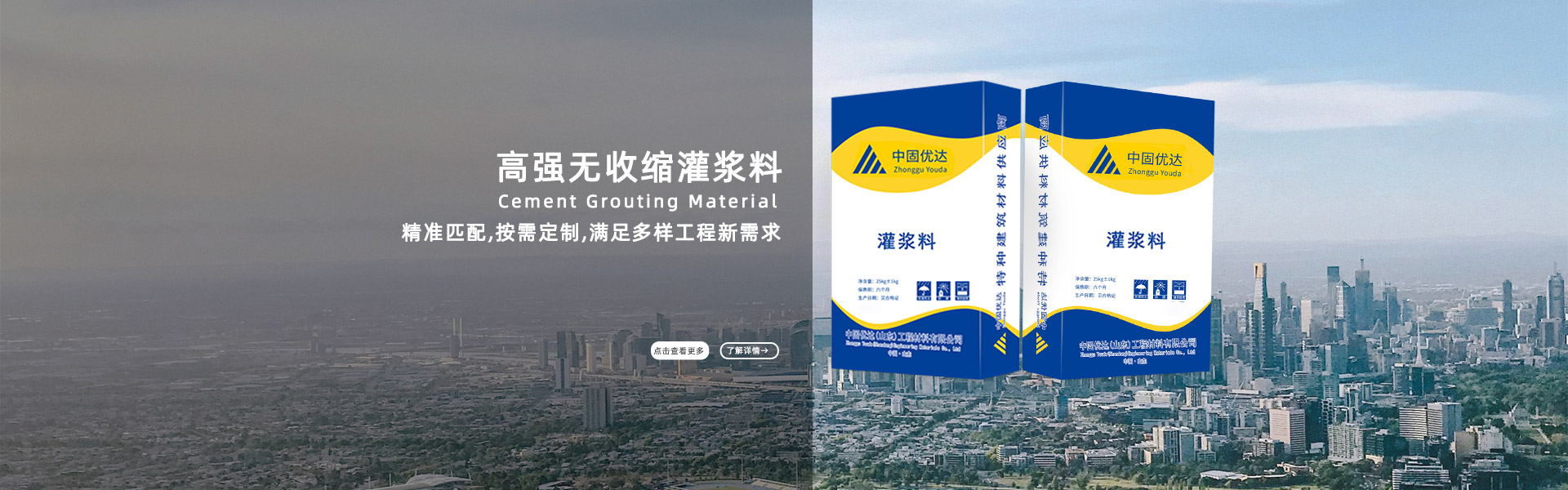
zhongguyouda Sealing Material (Sealing Material) is a kind of special Sealing Material (Sealing Material) with cement as binder, compound admixture and high-strength aggregate. It can be used after adding water and stirring on site. It has the characteristics of no shrinkage, high strength and easy construction. It is suitable for the Sealing Material of various equipment pads.
2. Scope of application of Sealing Material (Sealing Material)
1. Sealing Material (Sealing Material) is mainly used for the construction of Sealing Material and concrete cushion layer of equipment installation projects.
2.Technical performance
2. Technical indicators such as the strength and expansion rate of the seat slurry (sealing material) are as follows:
Test items | Performance requirements |
Compressive strength (MPA) | 1d≥20, 3d≥40, 28d≥60≥ |
Expansion rate (%) | 0.02 |
3. How to use the mortar (sealing material)
1. Roughen the surface of the foundation, and the height difference of the concave and convex surface should be controlled within 2CM. The surface should be cleaned and should not have oil stains, floating dust and loose concrete. The foundation surface should be wetted with water 1 hour before the mortar is applied, and the surface water should be cleared at the beginning of the mortar application. Make a trapezoidal mold according to the size of the pad and the height of the mortar.
2. When mixing the mortar, use manual or mechanical stirring according to the water consumption range provided by the manufacturer, and it must be even.
3. When the stirred slurry can be kneaded into a ball, it can be used. Inject the stirred seat slurry (seal material) into the mold body in place. When pouring, it should be rammed layer by layer. The thickness of each layer should be controlled at about 50MM. The surface shape of the slurry should be an arc with high in the middle and low around, which is conducive to the removal of air when placing the pad.
4. When the water marks on the surface of the seat slurry (seal material) disappear (depending on the construction environment temperature), the pad can be placed and the elevation can be measured. The pad should be placed on the seat slurry (seal material) and pressed by hand. Use a wooden hammer to knock on the surface of the pad to make it fall steadily. Do not knock obliquely when knocking. Stop knocking after the pad falls to the specified elevation, and check the pad elevation again.
Key Features & Benefits
Superior Bond Strength: Ensures excellent adhesion to concrete, anhydrite, cement screeds, plywood, and ceramic tiles.
High Early & Final Strength: Achieves rapid walk-on time and high long-term durability.
Excellent Flowability & Self-Leveling: Easily spreads and levels itself for smooth, flat surfaces with minimal effort.
Reduced Shrinkage: Minimizes cracking risk for a more reliable finish.
Pumpable: Suitable for large-area applications using mechanical pumps.
Moisture Tolerant: Can be applied to slightly damp substrates (consult technical data sheet for specifics).
Versatile Thickness: Suitable for both thin bonding layers and thicker leveling screeds.
Low Dust Generation: Improves on-site working conditions.
Technical Parameters
Parameter | Value / Description | Standard |
Base Material | Cement, specially graded aggregates, polymers | - |
Consistency | Fluid, self-leveling | EN 13813 |
Application Thickness | Bonding Layer: 3 - 10 mm | EN 13813 |
Compressive Strength | ≥ 15 MPa @ 7 days | EN 13813 |
Flexural Strength | ≥ 5 MPa @ 28 days | EN 13813 |
Bond Strength (to concrete) | > 1.5 MPa @ 28 days (typically exceeds 2.0 MPa) | EN 1542 / EN 13813 |
Drying Time (Walk-on) | ~ 24-48 hours (depends on thickness & conditions) | - |
Drying Time (Light Traffic) | ~ 3-7 days | - |
Drying Time (Final Flooring) | Typically 1 week per cm of thickness, plus margin (Verify moisture content!) | - |
Frost Resistance | Excellent (when fully cured) | EN 13813 |
Packaging | 25 kg multi-wall paper bags | - |
Shelf Life | 12 months (original, unopened packaging, dry storage) | - |
Primary Applications
Creating Level Subfloors (Screeds): Over concrete slabs, insulation boards (PIR, EPS, XPS), underfloor heating pipes, acoustic layers, and existing uneven floors.
Bonding Layer: For adhering new screeds securely to existing substrates like concrete, cement screeds, or anhydrite screeds (after priming).
Repair & Patching: Leveling damaged or uneven concrete floors prior to final flooring installation.
Preparing Subfloors: For direct application of:
Resilient Flooring (LVT, Vinyl Sheet, Linoleum)
Textiles & Carpets
Engineered Wood & Laminate Flooring
Ceramic & Stone Tiles (with suitable adhesive)
Epoxy/PU Coatings
Underfloor Heating Systems: Ideal encapsulation layer due to good thermal conductivity and compatibility.
Renovation Projects: Perfect for modernizing old floors quickly and effectively.
Sales hotline: +8616772555775 Mr. Huang
Technical Support: +8616730230785 Mr. ZhouEmail:[email protected]
Technical Support: +8616730230785 Mr. Zhou


 Online Service